Sunday, September 25, 2011

One-Trick Pony

When I applied to PC, I recall writing in my journal something to the effect of: “But how will I ever relate to anyone who hasn’t been reared on the important moral lessons brought forth from countless youthful hours spent in front of the television.” I worried - would I be able to find a deeper connection with someone in a remote African village who doesn’t get references to Tootie, isn’t familiar with the Disney afternoon, and can’t sing the theme song to the Garry Shandling Show? It was a valid concern then, and here I am, living in my Indonesian world, forced to figure out ways to build bridges with not so much as a familiar catch phrase or common commercial jingle between us. 

Let’s be honest, folks. I don’t bring much to the table here. Now that my initial 3 months at site are up, my figurative sauce has lost a bit of its sizzle. After initial introductions, small talk, and discussions about food, my go-to of identifying pop culture commonalities just isn’t there anymore. I tried immersing myself in Indonesian Cinetron until I realized most of my students live in a pesantren where there is no TV. After going to class all day, they return to a boarding house where they study the Koran until bedtime. Not much material to work with there. 

Yes, yet again, the Peace Corps experience has held its magic mirror up to this pale, sweaty, grinning mug. It has exposed that roughly 61% of my moral compass, life lessons, and topics of daily conversation come from television, movies, and music produced prior to 1999. It is a thorny truth that has been difficult to admit. Yet, there it is. It will remain a personal challenge that I, alone, will have to confront day in and day out. I have to live with the sad fact that not once, not twice - but three separate times this week, I caught myself wishing I had brought the popular film “Swing Kids” with me. While riding my bike or mandiing I alternate whistling “I Got You” by the Split Endz, Radiohead’s “No Surprises”, and the theme song to Diff’rent Strokes. Yeah, it may be time to update and reinvent a little. 

Now that the honeymoon is over, it’s go time. Like a young Marcia Brady eagerly signing up for all of her school’s extracurricular activities, I found myself trying everything these past couple of weeks. I hit the badminton court in the early AM with the guys, I went to the student scouts meeting and failed miserably at all of the games they played, I kicked off the school’s first chapter of an English Club, and I have been building up mileage to route my runs to all of the teacher’s houses to get more face time with them.

And then. A breakthrough. 

I was asked to compete with our school’s Dharma Wanita group. All of the female teachers, staff, and wives of male teachers meet once a month and wear these keen peach uniforms. 

Bu Juadah forgot her shoes, so she paired her Dharma Wanita uniform with some killer sneaks. I think it really makes the outfit.
They discuss issues, hold elections (I am a member of the social and culture committee), sing, pray, have a lottery for door prizes, and contribute to a savings program. Our group was competing against all other Dharma Wanita groups in the desa. Competitions included grabbing coins out of a watermelon slathered in whipped cream using only your mouth and putting on make-up without a mirror. Since I never learned to put on make-up with a mirror and had internal political opinions on the event, I was slated for the coin grab.

Melon, coins, and cream ready for the event

Bu Yanti competing

But then I heard about sepak bola joget. I never played soccer, but I have always wanted to learn. Two additional things grabbed me here. 

1. All of the women playing had to wear sarungs. I have a deep jealousy of all the PC boys who get to lounge around in villages each day in these long, Javanese skirts made in a variety of colors and patterns. A chance for a girl to acceptably wear one was enticing.
Here is my host dad from training and Beji bro, Jay, in sarungs
2. Periodically during the game, music was played, and all players had to stop the game and dance. Again, a pretty sexist spin, but, glory be - dancing! Out in the open! How can I pass up a rare opportunity to move my dance stylings from the confines of a locked bedroom to the world at large? Here is a video of other teams playing: 


So, a quick text to my Beji bro to give me a quick review of the off-sides rule, and I officially switched events.  

In short, I found my special purpose. I am pretty sure we only kept advancing in the bracket because the crowd enjoyed seeing the giant bule do over-the-top dances, which included the Roger Rabbit, the Cabbage Patch, and a couple of “Hey Mickey” cheer moves. I found myself wishing I had had the foresight to learn the worm before coming to Indonesia. They should really put that in the prep information section of the Welcome Packet. Whether our team advanced on merit or pure celebrity factor - either way, really, everybody wins.

Here is our team and our 2nd place trophy. 


After one of our wins

If you can zoom, I believe you will find me doing "the swim" on the left.
We're number 2!
 
Thus, forthwith springs the joy of finding new room to grow. I now stalk the neighborhood kids playing in front of the masjids and police station to teach me soccer, which adds a new avenue of bonding (and occasional ridicule) to my repertoire.

After further reflection, though, maybe this personal challenge of pigeon-holing myself in a world of 1980's TV for so long could also be my greatest legacy. Maybe the 11th grade in my school will never successfully conjugate or properly use the verb “to be” in a sentence, but there is a good probability some of them will know the Thriller dance before I leave. And, my host niece has already learned the chorus to “Tomorrow” from Annie which makes for some killer duets when I come home from school. Yes, sirree, if I play my cards right, I may have found a course to my secondary project. 

Peace Corps – bridging worlds one outdated pop culture tidbit at a time.

Sunday, September 11, 2011

Ten Years

When we were in San Francisco, my brother, Mike, my sister, Colleen, and I were stalking a man on Fisherman’s Wharf. He scares unsuspecting tourists from behind scant branches he holds up in front of him. He then passes a bucket and asks for money from onlookers. It’s hilarious and can easily fill a good hour or two. Unfortunately, an overexcited couple decided to “help” the Bush Man by standing right beside him and idioticly grinning at any approaching target, ultimately giving away his location and spoiling the fun. They just didn’t get it. To this, my brother asked the age-old question: “Why do people always have to make it about themselves?” 

You know - I had no intention of writing anything on the 10th anniversary of September 11th. Discussing anything on this topic has a high risk of being trite, insensitive, political, and/or controversial. In general, I try to avoid all of these things, and I am not skilled enough as a writer to side-step these potential land mines. However, with lots of free time during the Ramadhan break, my mind has been wandering to it these days, not exactly because of the events, but simply because ten years ago, there is no way I would have guessed I would be sitting where I am today - which is eating a fried banana under a mosquito net in my bedroom in the largest Muslim country in the world. So, like the overexcited tourists (and most of my blog posts, for that matter), I'm going to make this all about me. 

Ten years ago I was living at my parents’ house, commuting every day to a job in Manhattan. I told myself I would stay at the suit job working for "the man" for six months only, and I often felt guilty about getting new work assignments as I knew I’d be leaving at any moment (fast forward 9 1/2 years, and I was still there).  Each morning, I’d wake up around 5:30am convincing myself that the sooner I got up, the sooner I could drive to the train and go back to sleep for the hour and half ride into the city. During summer months, I even had a scarf stashed in my work bag that I fashioned into a pillow to make the train sleep more enjoyable.

Ten years ago, I woke up when my train arrived in Grand Central and vaguely heard someone mention something about the Twin Towers. Walking through Grand Central is one of my favorite things – even when battling the illogical patterns of travelers racing across the floor. That day, it was eerie as there were significantly fewer people and those who were there were crowded around TVs at the Hudson Newsstand. Curious, but worried I'd be late for work, I made my way to the subway, taking one of the last 6 trains to 27th and Madison. I got there in time to realize what happened and to see the first tower fall on the many TVs around our call center. 

We still worked. I took phone calls from people worried about their money as I watched co-workers freaking out around me, and I got into a tiff over the phone with an insurance agent who demanded money. “Look, Maam, I’m not sure if you know what’s going on here, but I have no way of confirming for you when the market will open again.” That’s probably about as mean as I ever got on the phone. 

Strangely, I don’t remember much. We couldn’t go anywhere since all transportation was shut down. I remember getting an email through to my brother in DC and confirming he was OK. Phones weren’t working well, but, eventually, I talked to my mom. She said our friends from the neighborhood, the Lalors, were frantically trying to find their daughter who worked in the towers. I also contacted most of my friends who I thought might be close and cleared they were OK.

I went and got a sandwich at one point with a co-worker. We looked out at the smoke towering above the city into the sky and the mass exodus of dazed people walking north - some with remnants of what they had witnessed dusting their hair and clothes. Being 50 blocks and almost 3 miles away, what was happening down there was a totally different world. What these people walking by me might have seen was completely unknown to me.

Eventually when the trains started running, I went to Grand Central, got on a train to New Hamburg, and drove my green go-cart-like car with no pickup the 10 minutes home.
I don’t know what I thought on the train, I don’t know what I said to my parents or to my boyfriend when they were so happy to see me. I don’t think I even had the wherewithal to write anything down. I don’t remember much of anything except for constantly telling people concerned for me that I was so far away from anything that happened. I certainly didn’t need any sympathy, but I think people just wanted somewhere to direct their confusion and sadness. 

After watching plenty of television coverage, we went to the Lalor’s house around the block. They not only confirmed that their daughter, Sue, was not in the towers, but she also made her way upstate to her parents’ house along with her sister, Meghan. It also happened to be Meghan's birthday. The reason Sue had not been at work that day was because she was running late after baking Meg a birthday cake that morning. This has been dubbed the best birthday present ever (Happy 32, Meg!).

We ate pizza as Sue tried to remember employees’ names off the top of her head and write them down. As HR manager, and most likely one of the sole survivors of her NY office, she was communicating with the Chicago office to try to help find who might have been at work that day. I do remember her face when she recalled a pregnant woman who might have been in the building and Sue breaking into tears. Yes, I do remember that. And I remember feeling powerless.

I can’t imagine living in a place where something like this happens with any kind of frequency. The idea of the extent of the loss of innocent life is too much for my mind to handle, which is why I think I have chosen to never really process it all and still feel totally outside of it, as if I was in another country even though I was a short cab ride away.

People have gone to war, more have lost their lives or those of loved ones – I know almost nothing about these things. I like to keep things light because that is the luxury of growing up with the life I’ve had. People have gotten into fiery debates about mosque-building and racial profiling and countless other topics that, again, I am not smart enough to address expertly here. I do buy into the importance of safety; when an Indonesian student asks if she will be attacked if she comes to America for wearing a jilbab, I also feel it couldn’t hurt if we had a little more understanding across the board.

In reflecting on ten years, I haven't changed all that much. I got contacts (which I actually can't wear here), I had bangs for a little while (which I also can't have here - too hot), I've gained some wonderfully enjoyable family additions (nephew, nieces, sister-in-law), I've gained some new phobias, and, hopefully, I've gained a little perspective. Oh, right, and I finally stopped dragging my feet and joined the Peace Corps (I started an application in 2001 - it took slightly longer than planned).

I don’t have a particularly interesting story. I suffer no delusions of grandeur with what I am doing in Indonesia, which these days mostly consists of riding bikes and watching episodes of Party Down. I do not equate anything I do with that of men and women who serve to defend their country. The likelihood of me being near any terrorist cells is slim, and I doubt my playing hangman in class or jogging through villages would dissuade anyone who really wanted to carry through plans of attacking the US or the West. 

But, as I sit here after celebrating the most important Muslim holiday with my Indonesian family who has not only welcomed me into their home, but who every day I grow to love more and more - I do recognize in myself that there is a gap. There is a gap of understanding between my language and theirs, between my culture and theirs, and between my religion and theirs. I hope to bridge these in some small way in the next two years. I hope the line I, unfortunately, still have between "my" and "their" will eventually blur and fade - even if just a little.

As I reflect on the upcoming anniversary and how much or little I've changed in that time, tomorrow’s dinner crows tied up beside my house, and I feel a small sense of purpose and accomplishment from having finished assembling 300 some-odd snack boxes for my host sister's wedding (turns out I am an awesome snack box maker). As my family banters back and forth in Javanese in the next room and I nurse the sores on my fingers from having stapled those 300 boxes, all I know is  - ten years later, there is nowhere else I’d rather be.

Wednesday, September 7, 2011

Idul Fitri: Forgiveness and Ice Cream

My friend Diem and I used to watch a movie from the early 80s that she had recorded from TV called “Old Enough”.  The main character was a girl at an awkward age who meets an unlikely best friend from the wrong side of the tracks. The friend also happens to be Catholic, and after the pair shoplifts some nail polish, the best friend assuages the main character’s worries by letting her know: “You just go to confession, and everything will be ok.” 

Diem and I got a real kick out of this philosophy – purposely doing something wrong, thinking you could just go to confession afterward to clean the slate. Not exactly sound theology. Similarly, in a delightful 30 Rock episode, Tracy Jordan has a similar view of confession until Jack Donaghy sets him straight. In addition, he informs Tracy that being Catholic also brings constant, colossal, spirit-crushing guilt. So true. 

So – the theme of forgiveness. One thing I am still adjusting to culturally in my village is the constant formality and requests for pardon. Every speech, most conversations, and even some text messages are concluded with a formal apology in the event anything was said that could cause any offense. As a Westerner trained to tell it like it is and always striving to use time more efficiently, it always seems excessive. As I think about it now, though, as a person raised Catholic, the standard martyr-like confessions and requests expertly-laced with a dose of guilt do feel slightly familiar.  

It only seems fitting that the close of Ramadhan festivities of Idul Fitri, in Indonesia (referred to as Eid, or Eid-ul Fitr in most other countries) is celebrated by a day of visiting everyone you know and formally asking for their forgiveness. This is a tradition particular to Indonesia. Each family waits at their house dressed in their brand new clothes (and sometimes in a newly-painted house) ready to field the incoming neighbors and family with a full supply of snacks, absolution, and some pocket change for the kids. People dispense money, cookies, forgiveness, and gratitude in a sort of bizarro Halloween/Thanksgiving. In short, it’s awesome.

I really enjoyed the idea of walking around the town and just saying “hey” to all your neighbors – or in this case “Mohon maaf lahir dan batin” or “Forgive my physical and emotional wrongdoings,” but I think the “hey” is implied. It’s such a good idea - starting fresh but not in a behind-the-screen-to-Father-Hickey kind of way. This method focuses on maintaining relationships and re-building bridges directly with the people closest to you. Oh, and then you eat cookies, or in my case - ice cream. Sure beats five Hail Mary’s.

My sister Ana, my cousin Yoonie, and me making the rounds to the neighbors houses.

The fam parading to the next house

My cousin Ari asking for forgiveness (and then he got a snack)


Some of my fav neighborhood ruffians going around asking for money

Running into other families from our street making the rounds

Hanging at my aunt Bu Har's place with some of the fam after completing our circuit.

Ice cream man

Yay! Ice cream! Forgiveness never tasted so good!

Here's a round of folks coming to my aunt's house.

And another family leaving the house across the street

If there are not enough snacks, just grab a mango from the tree outside.
Watching my host niece count up her booty, I was taken back to emptying pillow cases full of candy onto my parents’ playroom floor with the Nguyens, Goob, Meg, and anyone else who happened to Trick or Treat in the neighborhood that year. We would then commence high-stakes trading with Nestle Crunch bars, Snickers, and Milky Ways as our commodities until we all were satisfied with our take.

My niece Ila counting up her rupiah

The choice of houses is also intriguing. We didn’t visit every house on our street, and I am still not clear as to why. Is it similar to our plotting to hit the Reynold’s house on Brothers Road because they gave out king-sized candy bars and skipping the houses that gave out pennies and Mary Janes? Do you go where there is more bang for your forgiveness buck? I don’t know.  

Idul Fitri Prep and the Last Days of Ramadhan*
The preparations for Idul Fitri, however, begin weeks before. This is the time some Indonesians paint their house anticipating many visitors. And there is no “eggshell white” or “cobalt blue” in these parts. Oh, no sir. They really go for it. Here is our house freshly painted for Idul Fitri. 

Our house painted orange, green and pink for Idul Fitri.


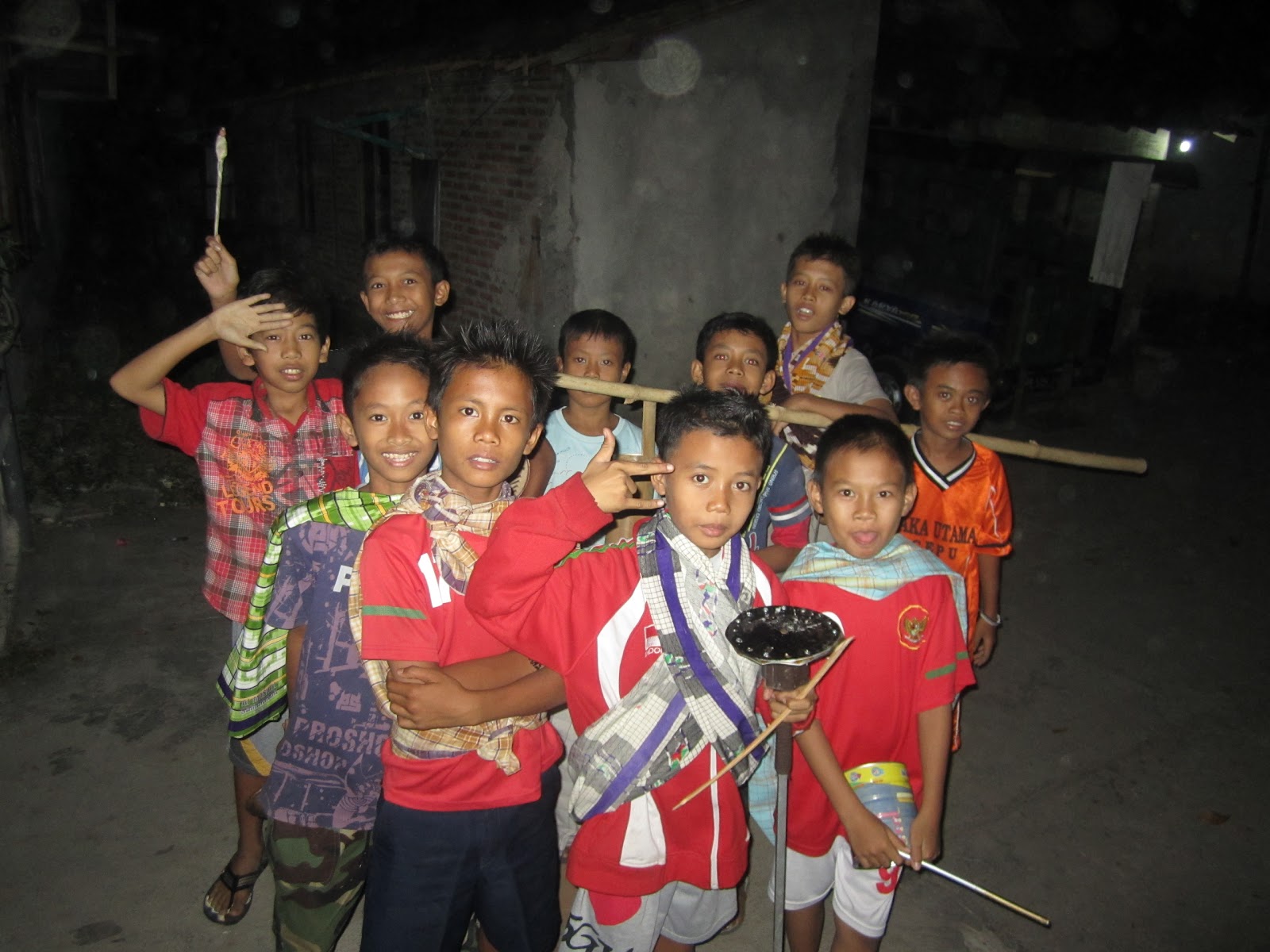
I finally caught these guys on film the last night of Ramadhan.* This is part of the crowd who would wake up our village at 1:30am each night for Sahur.
Neighborhood kids banging pots and drums through the streets every night of Ramadhan

I think the neighborhood stray cats were hit hardest by Ramadhan. With no food around for full days, there were half-dead cats lying everywhere. Here's one on our porch after he stole a fish from underneath the not-so-secure table cover intended to keep varmints out.
Cucing jahat
In Indonesia, it is also customary for all family members to return to the desas to be with family, so the cities empty out and travel becomes a hellish nightmare, which Indos seem to endure happily. This is called mudik. Below, I am sitting with a cousin who drove with her family for 12 hours from Jakarta to come to my village for Idul Fitri.
Me and my cousin watching the parade of action on the main road.

As we walked down the street, one families’ visitors were getting ready to hit the hay right out on the porch in front of the house. Most of my family slept at my aunt's house nearby.
Sleeping on the floor is where it's at in these parts, and when 5-20 family members come home, it becomes one giant slumber party.
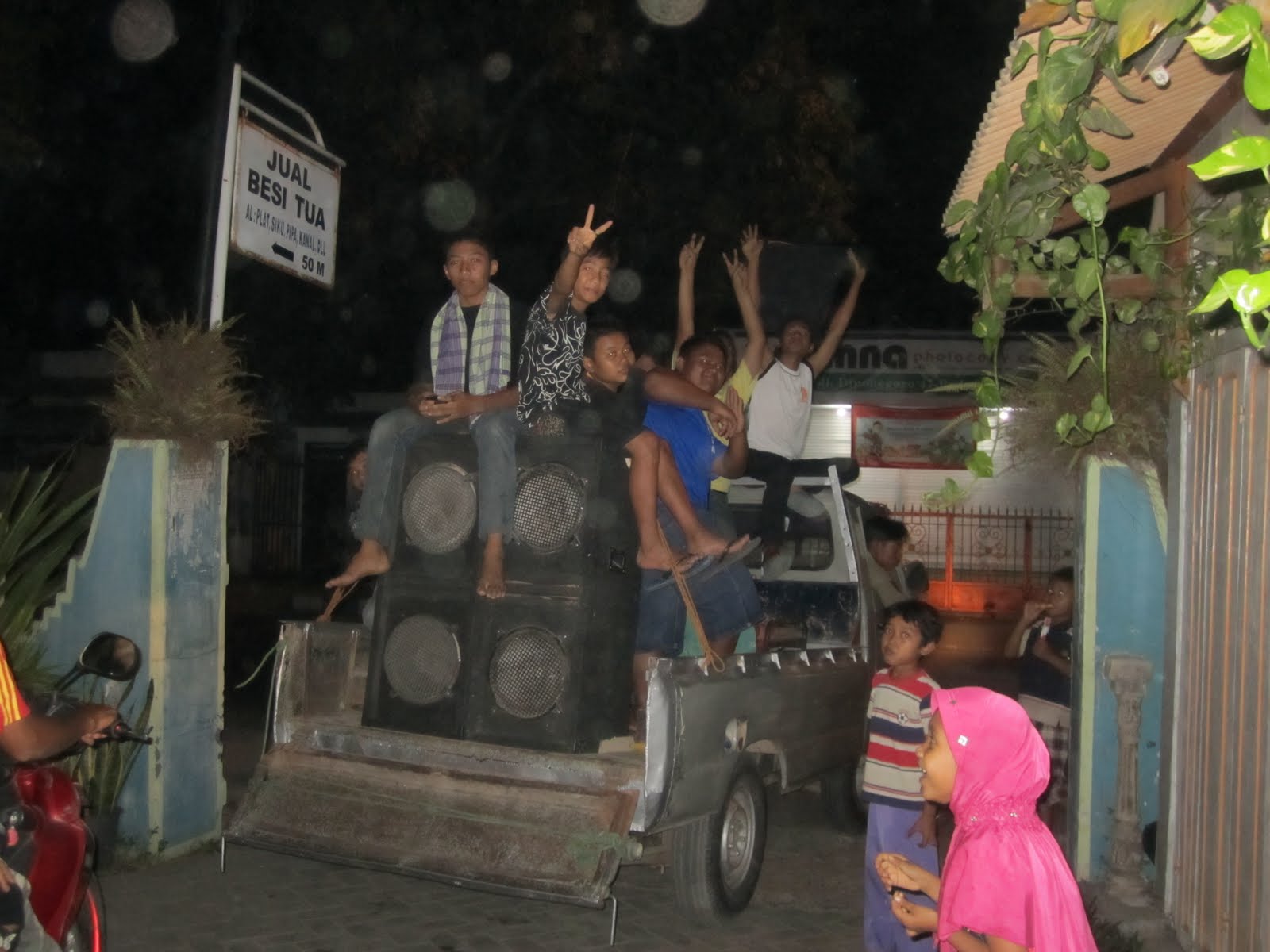
We watched festivities on the main road where there were fireworks, firecrackers, and an entertaining parade of trucks carting around masses of kids blasting music from huge woofers. 
Here are some of the kids crowding into the back of a truck blasting tunes.
This group passing by was our favorite. They shot fire into the air. I am confident every safety precaution was taken.

Here are some of my village peeps. I rarely see them in their jilbabs, but they were donning for the big event.
Rindu Ramadhan
I miss it. I really enjoyed my experience. It got me to wondering if I could do it in the US. Maybe I'll try it one year. OK - adding it to the list. 

And celebrating Idul Fitri felt like home. Journeying to Irish Grandma's in Long Island wasn't necessarily mudik, but occasionally my dad would try to sneak in a Chuck Girard casette making the trip a little less bearable. In the early afternoon, I was sitting around with my Indonesian host family after we were tuckered out from all the repenting and cookie-eating. Jilbabs were coming off, everyone lacked the luster they had earlier when the day was new, and everyone was content to veg out. I was taken back to lounging around the backroom at Grandma's, watching TV with my brothers and sister as I sat in itchy tights on the brown couch that was one notch below what could be considered comfortable. We would fade in and out of naps as we could hear the dining room din of grownups stirring sugar into tea cups as they bantered back and forth. I remember being dumb-founded as to why anyone would enjoy just sitting around talking for so long.

As I was reminiscing, taking in the Javanese chatter around me, someone handed me a tin of cookies. Danish butter cookies. The ones my Irish Grandma would always have at her house even though we only liked two or three of the varieties in those crinkly white sleeves.

And here they were - Irish Grandma's Danish butter cookies...made in Indonesia.

And the circle is complete.


*Idul Fitri Confusion

The close of Ramadhan was accompanied by the same confusion that denotes most events and schedules in Indonesia. Fasting ended the night of September 29th. For my family. But they follow Muhammadiyah teaching. Most of the Indonesian population is NU, or Nahdlatul Ulama. 


From what I gather, NU is a grass roots organization that allows for Indonesians to still follow certain cultural traditions that may not be rooted in Islam. For instance, one of my favorite traditions is the tahlil when someone dies. Javanese come together to celebrate and pray 3 days, 7 days, 40 days,100 days, 1 year, 2 years and 1000 days after someone’s death (I am not 100% on the days as different people have said different things). I really love this tradition as I feel it is such a wonderful way to pay respects and continue to remember loved ones lost. Everyone gets together, prays, and takes home snack boxes. Because this tradition is rooted in Java’s animistic history, generally, Muhummadiyah does not follow it, trying to purify Islam of any non-Islam influences.


Another thing I didn’t know about Islam – because the Islamic calendar is a lunar calendar, Ramadhan ends when the crescent moon is spotted in the sky. This poses some difficulty for modern Muslims as they sort of don’t know when the fasting will end and it can vary from place to place. In America, this is also a difficult thing to explain to your boss when you are trying to take a vacation day to celebrate Eid (whereas, here, the country shuts down for two full days). “Well, the moon wasn’t spotted yet, so can I push back my day off?” 


Imam Khalid Latif, Executive Director for NYU’s Islamic Center explains the end of Ramadhan in his online Ramadhan reflections:  

“Traditionally, most would require the actual seeing of the crescent moon with the naked eye. If the moon was not visible on the 29th night, then the month would extend one more day for a total of 30 days before the new month began. Contemporary opinions have developed that utilize calculations to determine the start and end of the months. Those who follow the latter have set Tuesday as the first of Shawwal, the month that follows Ramadan, as well as Eid-ul Fitr, an Islamic holiday that follows the month of fasting. If you are interested in learning more about it, Shaykh Hamza Yusuf, a prominent American-born Muslim Scholar and co-founder of Zaytuna College, the first Muslim College in the USA, has written an excellent book on the subject entitled "Caesarean Moon Births."


So, in Indonesia, for Muhammadiyah - Idul Fitri began on Tuesday, the 30th. NU followed the determination of the Indonesian government which announced late on the 29th that there would be one more day of fasting, making Idul Fitri for them on Wednesday, the 31st. As a result, while my family was eating and carrying on like Ramadhan was over, all of our neighbors were still fasting. My family slept most of the 30th and really celebrated with everyone else on the 31st.

Monday, September 5, 2011

Period Piece

I remember always getting an uncomfortable feeling when Ann Romano insisted on being called Ms. instead of Mrs. or Miss on “One Day at a Time”. I didn’t get why she had to make a big deal of such a little thing. In general, I stay middle-of-the-road on gender issues mostly because I am lazy. However, I was pretty bummed when my full fasting experience and possibility of participating in Tarawih prayers were squashed because of female issues. If you refer to my previous post on the “Top 5 Things I Didn't Know About the Holy Month of Ramadhan" or put two and two together on the clever title of this post (stolen, of course), you’ll get my drift. I understand the reasons, and I was assured that female Muslims praying from home receive special blessings that the men do not. Occasionally, though, it becomes difficult not to veer down the road of the privileged, Western white woman with a sense of entitlement/judgement and get to thinking that a lot of rules in regard to women across the spectrum of religions, while they may have historical foundations, are just bullfrak (I’ve been watching a lot of Battlestar Gallactica recently). And sometimes I can see where Ms. Romano was coming from. 

Despicable Confession: In the spirit of my upcoming blog post on forgiveness (stay tuned), I will confess that one or two times times on the subway, I purposely sat next to the Orthodox Jewish guys out of sheer curiosity to see how they would react as they are not allowed to have contact with a woman who is menstruating. Sometimes they would get up and move, but generally, they would stay sitting there.

Note: I never did it when I was actually in my time of the month, and I wouldn’t actually touch them - but this doesn’t make my intentions any less deplorable. 

However, I reminded myself that I am here to learn. And while I am trying to understand the experience of fasting, I am not fully participating as I am not Muslim and do not follow the prayers that go along with Ramadhan fasting. And, let’s keep perspective that I was perturbed because I wanted to continue to experience the practice of starving myself during the day, and I was being told to eat. Yeah. Not exactly persecution. 

This highlights another interesting cultural difference between Indonesia and America. In America, it is generally taboo to mention menstruation. In my village, however, it is right out there as a part of daily conversation. I have had more than one conversation with my Indonesian host dad about menstruation. Current tally of conversations with American dad = zero. I have grown to prefer the openness as it ends up being easier all around (please reference the section titled “Small Talk” in the Culture tab of this blog for more info) even if it still freaks some people out.

But in America, female Muslims, after informing co-workers that they are fasting during Ramadhan, can’t very well point out, “Oh yeah, but I can eat when I have my period.” So, some fake it. They fake fasting. They end up not eating during the course of the work day, just so they don’t have to go through the awkward explanation of why they are allowed to eat. Good glory, people. Reach out and hug your favorite Muslim female today. What a chore. 

Note: This concludes the menstruation section of this blog post for those who now want to open their eyes. 

In a happy ending to my story, even though I was not able to participate in Tarawih prayers, my host dad, seeing my disappointment, welcomed me to come along to the Eid prayer to celebrate the end of Ramadhan.

Score!
After begging my host dad, I was able to participate in the Idul Fitri prayers - I enjoyed knowing you are welcome to bring Hello Kitty purses or take a nap as needed.


I was also interested to find it a lot like going to Church. Everyone stands up and sits down at the same time, they say the same things, they shake hands, and there is a long speech from a guy. Also, no jeans or sloppy tops.

This is taken following the prayer. All the women must be fully covered during the motion of the prayer. I had to study with my host mom the night before and borrow my host sister's garb.

I was excited that I may be able to "blend" in for once as everyone would be fully covered. Unfortunately, most women wear white, and my sister's prayer shawl is deep purple. Instead of blending as I hoped, I looked like a giant, four-eyed, white-faced Grimace. I was hard to miss. All photographic evidence of this has since been destroyed.

Friday, August 26, 2011

Good Day in the Desa

It was over a year ago that I sat in the NY Peace Corps office on Varick Street listening to a panel of returned PCVs discuss their experiences. A member of the audience asked them each to describe a bad day and a good day at site. One former PCV talked about receiving hand-written notes from fellow volunteers passed via Ugandan taxi cab drivers. Another chose successfully washing/drying clothes during the rainy season in Honduras as a memorable high point. I sat there in my business suit and Onitsuka Tiger sneaks (I miss you, so) after a long day of work, trying to comprehend what my life would be like if I joined. If I actually did this thing, what would I consider a good day?*

Well, here you go. Picture it – Bojonegoro, 2011...


Pagi Pagi (Early Morning)
You wake up at 3:40am - 10 minutes late for Sahur, and your host ibu seems a little perturbed, but you make a joke about dreaming about cake and that seems to blow things over. You down 3 glasses of cold water and then eat rice, fish, fried tempe, a fried egg, and top it off with papaya, salak, a nice cup of hot chocolate and then a couple more glasses of water for good measure. Oddly – today no one puts any food on your plate or asks you to “tamba lagi” (take again). That, right there, sets the tone for a great day. Today, you are the master of your makan (eating) domain! 

You pop your PC pre-natal vitamin, hit the kamar kecil (bathroom), do some flossing, and then head back to sleep for 2 more hours. Luckily it is a little chilly, and you can relish the rare feeling of wanting to cozy under covers.  

Pagi (Morning)
You get to sleep in until 6am, sweep your room a bit, and then hit the mandi. Wednesdays are the butterfly collar, tie, and shoulder pads uniform day, but somehow, today, you make it work. You throw your wet hair up in an Anne Shirley-type ‘do, pack up your laptop, koosh ball, stickers and class lists and take to the bike. You leave early enough so you can do a smooth pedal from the village onto the main road without your normal spaz reactions upon sighting oncoming traffic. You hit the light just right and turn at the intersection like a breeze. No accidents were caused today.
Aside: there had been a slight incident a couple of weeks ago where two motorcycles collided feet from you due to one driver doing a double-take upon sighting your skin.
You successfully avoid hitting the hoards of students walking to school and evade getting hit by the numerous motorcycles and buses whizzing by. 

You arrive at school, chat with a couple of students and enter the teacher room which is still empty. You juice up the laptop and catch Ma and Pa on skype for a quick video chat before the teachers start rolling in. You get the latest details on the weekend events in Wappingers Falls and wish them a “Good Night” as you get ready to start your day. 

You share plans quickly with your counterpart on what you will teach about 5 minutes before you are supposed to enter the classroom. You successfully pull off the activities you planned and your counterpart improves upon them, making the class even more enjoyable for the students. You do this for 4 more classes. More importantly, every student in the 10th grade spoke English today.

Siang (Around Noon-time)
After class you are asked to attend a meeting where they ask you to be on a team to design a curriculum for an advanced English class. You break it to the them that you really have no idea what you are doing. You say you will try to help, and they seem to be ok with that.

Students come to speak with you in the teacher room which is exciting because they are always painfully shy. OK – you forced them to do this by assigning “You must talk to Ms. Erin for 1 minute outside of class” as homework, but you will take the obligatory interactions as a success anyway. 

In between students popping in and trying not to look busy, you discuss elections and campaigning in America with a fellow teacher who you have secretly dubbed your BFF.  Another teacher you want to be friends with sits next to you and wants to see pictures on your laptop of Brooklyn and family and friends. You show her these, and you love that the teachers are learning the names of your nieces and nephews. 

At around 1pm, you ride your bike home, and it is “sepi” or quiet, so you can cross the main road with ease and hear the greetings from some of the neighbors and village kids, “Ms Erin!” 

You mandi (bathe) to wash the half a day's sweat off and change into your pajamas (John Jay X-C Tshirt and Hello Kitty shorts). You play a few rounds of bekel (sort of like jax) with your host niece and watch as your host dad falls asleep upright while sitting on the couch. After being urged several times to “istirahat” (rest), you settle in for a nap while listening to your favorite playlist on your ipod. You have about an hour and a half before the kids starting peaking in your bedroom window to go for an afternoon bike ride through the villages. Before bike time, however, you get a call from one of the Beji Bros and mengobrol (chat) a bit, swapping tales. 

Sore (Afternoon)
At around 4pm, the bike posse (today consisting of Ila, Friska, Putri, Ajeng, and Imas) takes you on a different route and you encounter a whole other part of the desa you never knew existed. You run into a few familiar faces and new babies to scare along the way. You wish you brought your camera as you follow the trail of kids competing to coast on their bikes with feet off the pedals and legs straddled in the air. You pass through the smoke clouds from the massive ovens baking bricks made from the clay taken from along the Solo River. You give the workers, dark-skinned and sweaty from the heat, a quick “Mangga” (Javanese greeting), and they throw you a wave. It is cool and breezy, and one of the regular ibus you usually greet along the way calls out “Mau hujan”. It wants to rain. 

You stop at your regular spot along the river, and the kids have taken to competing at throwing rocks as far as they can into it. They urge you to throw one and you figure since there are so few things you do well (i.e. bikeriding, hulahooping, bekel-playing), you need to throw these kids a bone, so you impress them with a lofty heave to the center of the river. You hear one of the local kids calling “bule” from his house, but you know his name is Agil, and he just wants you to talk to him. 

You look out on the Solo River speckled with fishermen in perahu (small boats), and you gaze across the way at the farmers tending to goats and sheep. The sun is setting in one of those rays-shooting-out-from-behind the-clouds-and-you-have-the-promise-that-everything-will-be-OK kind of sunsets. You look at these kids as they ask you how to say “sapi” in English (cow), and you wish you could gather them up in your arms or video tape them exactly how they are right now as a rag-tag, ever-changing team of village posse who often trade bikes and switch on and off as to who rides "di belakang" (on the rack in the back). You wonder what they will be like in two more years or even when they grow up, and you hope their dreams of becoming teachers, doctors, police women, and midwives come true. And you immediately flash forward to June 2013 and are momentarily overcome, literally losing your breath, at the thought of ever having to say good-bye to them – because you know it may be forever. 

You take the ride with the posse back home realizing you’ve picked up three newcomers along the way. Your “bule”-calling pal, Agil, along with Anisa and Ifa ride all the way to your house from the next village so they can know where you live. You encourage them to return home before maghrib so as not to endanger yourself with a kidnapping rep. You shoot a “hey” to your 11-year old best friend across the jalan (street) as you pull up to your house, and your host niece laughs that you still have to walk your bike up the narrow entrance to your driveway. 

Around Maghrib (Evening)
You throw wonderfully cold buckets of water over yourself in the mandi (bath) and retire to your room to jot down a few notes down about your day so you won’t forget when you look back 1, 5, 10, 20 years from now. 

You hear the call for maghrib as your niece pokes her face in your window from outside, “Ms. Erin, makan!” You open your bedroom door, walk to the fridge and feel the refreshment of cold water flowing down your throat as you think nothing could ever be quite as satisfying.

You eat fish, rice, and fruit until full. You drink your chocolate milk, and you lie on the cold, linoleum floor with your family in front of the TV. The fan your host dad fixed starts to make an odd, random screeching sound. It does this every night, but it never ceases being funny, so you all enjoy a hearty laugh over it together. Your niece has learned how to say, “Fan cry!” in English, and that keeps the laughs going. 

Malam (Night)
Most of your family goes to the masjid for Tareewah prayers, and you start to fall asleep right there on the Winnie the Pooh mat that only a few short weeks ago you doubted could ever be considered comfortable (yet your host ibu sleeps there most nights). The fact that your eyes are closed in no way disparages your niece from continuing to speak to you in Indonesian. This is an interesting twist from the extreme terror you inspired in her only a few short weeks ago. She is excitedly speaking about Idul Fitri when all of her family will come to the village to celebrate. She asks you how to say, “Saudara saya datang ke sini,” in English. You tell her, “My brother will come here,” and she repeats it to herself as you fade off to sleep around 7:45pm. 


Sempurna. Perfect.


*For those who enjoy the dark side and want a taste of elements of a bad day, please consider the following:
  • You are told unceasingly when and how much to eat. Most days you can laugh off and ignore it, but, at times, when the chips are down, it can really send you over the edge. 
  • You are often sitting in rooms filled with people speaking Javanese, of which you know little. This could last for hours.  
  • You are sometimes given news way after you wish you knew it or not told the whole story (I was asked to meet some kids in a nearby village at 8am. I was then told at 9:30am it would be at 10am and it included riding my bike on a rock road that felt like I was riding over lumpy dead bodies for a good 30 minutes in the hot sun without having eaten or drank anything. The whole time I was trying to focus on not falling over, I was being followed by a fellow teacher on a motor cycle and expected to answer questions. "Meeting the kids" meant teaching them English for 2 hours with nothing prepared).   
  • The times you want to be alone are the times your niece and the village kids have their faces pressed up against your window as you try to change your clothes. They only consider your shriek of terror to be a sign of encouragement to continue to invade your privacy (note: privacy is a totally different concept here, but still, it can get to you).
  • The times you wish you had someone around with whom you can communicate easily are the times you are alone.
  • You are constantly asked the obvious: "Are you washing clothes?" as I am crouching over a bucket of suds, scrubbing my school uniform. "Are you still ironing?" as I am running a hot iron across my NYL T-shirt, and so on. 
  • Your teacher wants you to read from the book in front of class for the full hour of class so the kids can learn pronunciation from a native speaker. They don’t even know the meaning of the words, so you wonder how focusing on pronunciation will help anyone. Half of the class is also asleep. You totally understand why because you are bored listening to yourself.
  • You are sitting in the teacher room when there are no classes scheduled for the day and wonder why people don't just go home. They'd be outta there so fast in America. You look around and some teachers have literally been staring ahead doing nothing for what seems to be hours. You try to use the time to look up ideas for teaching on the internet or write some lesson plans, but you are constantly told “you are always so busy". As a result, you have to somehow find time to prepare for class outside of school and spend the loads of free time at school just trying to look available to chat. 
  • Some days the coping mechanisms and the carefully placed Inception-like illusions you've constructed start to break down, and, briefly, you realize exactly how far away you are from the people you love - and that you can't just walk a block to your favorite BK hangout or randomly decide to jump on a train for dinner at Catalano's or a dance party and IHOP breakfast in CT.    
I am pretty sure I will face some of my worst days in Indonesia, but I feel pretty certain Indonesia also brings the promise of some of my best ones yet to come. 

To more good days in the desa...

    Tuesday, August 16, 2011

    Top 5 Things I Did Not Know About the Holy Month of Ramadhan

    I was reading up on Ramadhan to prepare for fasting with my community, and it is incredible just how little I know about Islam. Sad, really. And when I wanted to get an American Muslim’s perspective on how Ramadhan is spent and some advice on fasting, I was equally amazed to take stock and realize there was a shocking lack of Muslims in my crew. I always considered myself an equal opportunity friend-er, but, obviously, something is eskew when the hundreds of friends on facebook or otherwise, fail to reflect that almost a quarter of the world’s population is Muslim (granted, America’s make up is only 1% Muslim, but still). So I stalked the few peeps I do have for some advice and perspective, and I remain confident that two years in the world’s largest Muslim country will shift those scales just fine. 


    Here is a little background about Ramadhan:

    First off, Ramadhan is the ninth month of the Muslim calendar. It is when it is believed the Holy Quran was revealed to Muhammad. During this month, Muslims fast (fasting is called puasa in Indonesia), pray, and try to focus on being better people overall. In Indonesia, school days are shortened, and there is a lot of napping. 

    Fasting is also one of the five pillars of Islam. Below is a reminder if you forgot your Global Studies. I, for one, was too busy focusing on Mr. Dahnke’s bonus questions involving movie trivia to retain such important info. Fact: I got the highest test score on one of the 9th grade Global Studies exams by correctly answering the following bonus question: “In what city’s airport does Kevin’s mom meet John Candy in “Home Alone”? American education at its best. Anyway…

    The Five Pillars
    1)  To witness that there is no god but God (Allah) and that Muhammad is His Prophet
    2)  To perform the required prayers five times a day
    3)  To pay the zakat (alms giving to the poor)
    4)  To fast the month of Ramadhan
    5)  To perform the pilgrimage, or Hajj, to Mecca (if able).

    Here are the top 5 things I did not know about Ramadhan, but probably should have:

    1)   In addition to fasting (puasa) from food from sunrise to sunset, Muslims are also not allowed to drink anything, including water. I somehow missed the memo on this, and when I found out, I knew this would be the real challenge. I would wager to guess that at any given moment, my chin generates more perspiration than all the bodies in my village combined, so not being able to replenish fluids at will was particularly daunting. 

    2)  Some individuals are exempt from fasting: the elderly, the mentally ill, those who are sick, those traveling, pregnant women, and women who are menstruating (although the last four are expected to make up their days fasting at another time, and most pregnant women I know still fast). Children are also exempt, but, in my village, most children also fast - if not the whole day, then half day. 

    So, when I think about caving at all when I am a tad bit parched, I can look at the 55lb 8-yr-old playing cards across from me and maintain a little perspective on my own self-restraint. If pregnant women and children can do this, I should be able to nut up and power through (thanks to Feldman for bringing this phrase back to our lives). 

    This is similar to that time I was afraid to ride my bike across the Golden Gate Bridge and seriously considered turning back when a 6-yr-old breezily pedaled past me and onto the gusty pathway without any care at all. I was forced to cross shakily on my bike, petrified to look any direction but straight ahead, but I did it. It is actually a bit disconcerting how often the worry of being schooled by a pre-teen has determined my choices in life. 

    3)  Sahur – This is the meal consumed before the Fajr call to prayer during Ramadhan before the fast begins at sunrise. I am awoken at around 2am most nights by the sound of parading children banging on drums and yelling “Sahur” outside my window. I wonder why they do this so early because my family doesn’t eat Sahur until 3:30am. So I enjoy the ruckus a bit, go back to sleep, wake up again at 3:30am, down as much water as I possibly can, eat, and then go back to sleep almost bursting with rice and tempe. I will not be surprised if during this fasting exercise, I end up gaining weight.   

    4)  Buka Puasa or Iftar – At the call for Maghrib at around 5:30pm, Muslims can break the fast. Usually, my host dad will present me with some “es” (wonderfully cold drinks filled with fruit or coconut and loads of sugar), and he will say, “Makan, Mbak”. I opt for charging directly for the kulkas (fridge) and downing a liter or so of cold water before partaking in any food. After a full, hot day of teaching and talking, it truly does taste so good when it touches your lips. This is my favorite part of puasa. You can’t help but be thankful for all the blessings in life and be totally happy with something as simple as a cold glass of water. And each day I get to experience that same contentedness and gratitude. 

    5)  In addition to the five daily prayers, during Ramadhan Muslims recite a special prayer called the Taraweeh prayer (Night Prayer). My family goes to the masjid each night along with most of my village. I usually stay at home eating Kit Kats and watching the two English TV stations. Please note that if you see a notification that a piece called “A Few Good Men” will be coming up on the Asian network station, it is most likely not the popular film starring Tom Cruise that my brother-in-law so loves (“Who’s gonna do it, YOU, Lt Weinberg?”). It is a documentary on influential Asian men. I hope I have saved you the 30 minutes I spent sitting on my linoleum floor anticipating this treat. If I’ve reached one person, my efforts were not in vain. 

    My experience: Why fast?

    Many non-Muslim PCVs have chosen to fast along with their communities in a motion of solidarity. I mostly couldn’t bring myself to teach a room-full of starving and thirsty students without having any idea of how they felt.  

    In addition, I wanted to gain an appreciation for the Muslim experience of fasting in America. First off, in Indonesia the entire educational system, government, entertainment industry all take into account that most of the population is fasting, so days are shortened, most restaurants are closed, and popular TV characters are shown praying in the masjid or breaking fast together with Ramadhan incorporated into the storyline. Most of the Indonesian community is mobilizing around this event.

    I can only feel for Muslim Americans who have to endure walking past the allure of pizza joints, the beckoning aroma from street vendors, and pretending not to care that co-workers are downing coffee and snacking on office treats right in front of them. Additionally, the day is longer in the U.S. than it is in Indonesia. Indonesians cannot eat from about 4:15am until around 5:30pm when the sun goes down. Being further from the equator, sundown in the U.S. isn’t until around 8pm, so Americans have to stick it out longer. I am not sure I could hack that. From the few Muslim Americans I do know, they don’t seem to have a problem with these things. This only makes me more impressed having had a small taste of the exercise. They know they are fasting for a greater purpose, and they seem to easily withstand jerks like me in the office who persistently badger them to eat Mrs. Field's big cookie, totally unaware that it is Ramadhan. 

    Sorry guys. 

    My experience: Thoughts so far

    During the first week of fasting, even though I was successful in refraining from food and drink during daylight hours, I was finding it tough to stick to the “slow to anger” rule that also accompanies the fasting discipline. Fasting is supposed to make it difficult to be cross with your fellow man because you are experiencing what it is like to be hungry. It helps you empathize with the plight of those around you and makes you more giving, kind, and patient. Well, turns out I am pretty irritable when I have not eaten or drank any water. My tolerance for my fellow man seemed to be decreasing in direct proportion to the amount of my food and water intake*. The grumpiness really hit its peak when I had an uncomfortably angry reaction while watching a scene where Liz Lemon brings the writers of TGS cupcakes with candy bars baked inside. This really awakened a beast from within. So, to lessen the blow, I decided to take a lot of naps and submerge myself in cards and bike rides with the village kids. 

    Then, one day when I was lying down for my noon-day nap, something happened. I was full of energy. I was so inspired, I closed the curtains, flipped to Santigold’s “Lights Out” on the ipod, and decided it was time I checked to see if I still had my moves by way of a personal kamar tidur dance party. These moves were once aptly described by a co-worker as "Disney Dancing". After 4 months of living in a Footloose-style community that does not value breaking it down, I am happy to say my Disney Dancing skills have yet to atrophy. In fact, in my later years, my style interestingly reflects a new influence that can only be traced back to the art of semaphore flag signaling. Big, bold movements, people. As I semaphored my way around my bedroom, I thought fondly of and was boundlessly thankful for the never-ending supply of dance party partners I have awaiting me back home (Stamford Fitz's, Highland Fitz kids, DiRagos, NYC crew, etc) and the support they continually give me from half a globe away. So, somehow, even with no food in my stomach, I was full once again.

    Now, at day 16, I feel pretty good. I enjoy fasting. I like the challenge, the discipline, and it is easy now to make that choice to transcend what my body wants and subdue any urges. Also, it promotes a clear-headedness and peace of mind. This clear-headedness also helps me make wise decisions. For instance, should I take a mid-day nap after almost falling asleep in my school meeting earlier that day, or should I watch Dirty Dancing Havana Nights? Thanks to Ramadhan fasting, the choice was clear. Why should I succumb to my body’s feeble need for REM? I have proven I am stronger than that. Mind and soul over matter. Who needs sleep when I can learn of the Cuban revolution through the eyes of an unlikely couple destined to inspire each other to grow through dance. 

    Yes, Ramadhan brings this strength. Who knows what an additional 13 days will bring? 

    For further reading on Ramadhan or Islam in NY, NYU's Islamic Center has some great stuff. Thanks to Saba for the reference:  http://www.icnyu.org/

    *I am pretty sure I stole this thought from fellow PVC, Daniel Paulk, so I will send you the Rp 100 for the royalties, Daniel.